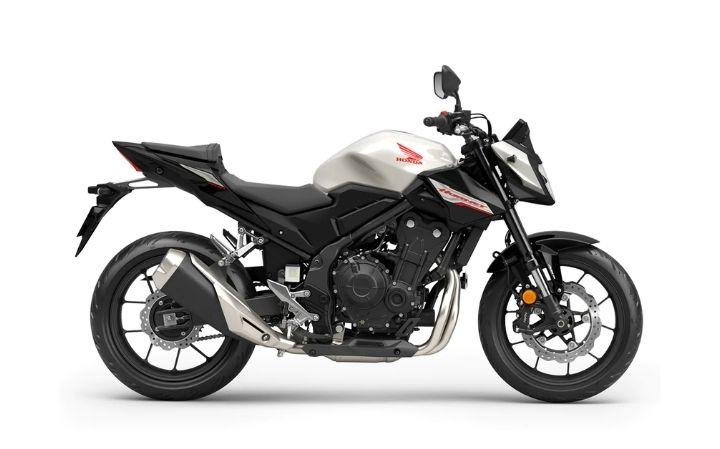
| Feature | Value |
|---|---|
| Brand | HONDA |
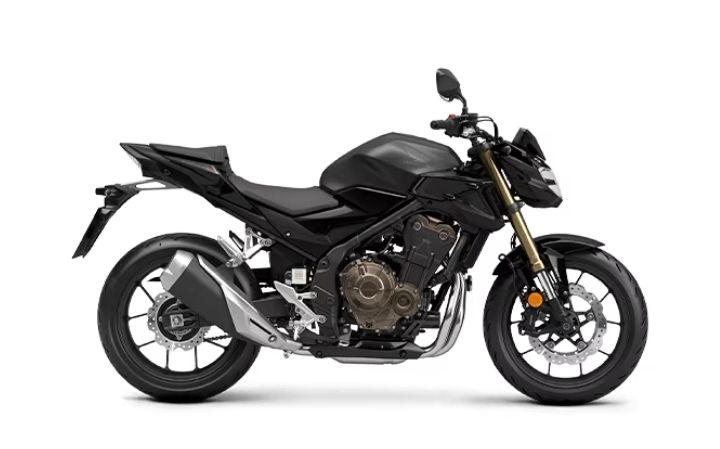
| Model | HONDA CB500 Hornet |
| Engine size | 500 cc |
| Power | 47 hp |
| Torque | 43 Nm |
| Cylinder / Valve | Double Cylinder, 8 valves |
| Weight | 188 kg (414 lb) |
| Front Brake | Dual 296mm x 4mm disc with Nissin radial-mount four piston calipers |
| Rear Brake | Single 240mm x 5mm disc with single piston caliper |
| Seat Height | 78.5 cm (30.9 in) |
| Front Tyre | 120/70ZR17M/C (58W) |
| Rear Tyre | 160/60ZR17M/C (69W) |
| Cooling | Liquid Cooled |
| Front Suspension | Showa 41mm SFF-BP USD forks, |
| Rear Suspension | Prolink mono with 5 stage pre-load adjuster, Steel hollow cross swingarm |
| Motorcycle Type | Naked |
| Top Speed | 188 km/h (117 mph) |
| Fuel Capacity | 17.7 L (4.7 US gal) |
| Fuel Consumption | 4.0 L/100 km (58.8 mpg US) |
| Prevalence of Service Network | |
| Service Quality | |
| Spare Parts Availability | |
| Price | $6,399 |
| For Other Motorcycle Price Lists | Click for HONDA Price List |
Spec-based reading of the Honda CB500 Hornet as a Naked: focus on the numbers that match how you ride — power, weight, seat height, and fuel range — then verify with a dealer test ride.
Pros
- Liquid cooling for more consistent heat management
Who is it for?
Best suited for street riders who want agile handling.
Commuting / city use
As a naked motorcycle, it suits agile street and back-road riding more than long touring comfort.
Highway / longer rides
Wind protection on long highway days depends on screens and rider preference.
Good for beginners?
Mid-range specs: suitability as a first bike depends on experience, training, and a proper test ride.
Seat height & rider fit
Seat height is about 785 mm (30.9 in) — mid-range, but personal fit still matters.
Fuel economy & range
Listed fuel use is about 4 L/100 km (~58.8 mpg US). With a ~17.7 L tank, theoretical range is around 443 km (real-world range varies).
Two-up riding
Two-up comfort depends on seat length, passenger pegs, and load capacity — check fit with a passenger before long trips.
Frequently asked questions
What is the top speed of the Honda CB500 Hornet?
Our specification data lists 188 km/h (117 mph) for the Honda CB500 Hornet.
How much horsepower does the Honda CB500 Hornet have?
Listed power is 47 hp.
How much torque does the Honda CB500 Hornet have?
Listed torque is 43 Nm.
What is the engine size of the Honda CB500 Hornet?
Engine displacement is listed as 500 cc.
How much does the Honda CB500 Hornet weigh?
Curb weight is listed at about 188 kg (414 lb).
What is the seat height of the Honda CB500 Hornet?
Seat height is about 785 mm (30.9 in).
What is the fuel economy of the Honda CB500 Hornet?
Listed consumption is about 4 L/100 km (about 58.8 mpg US).
What is the fuel range of the Honda CB500 Hornet?
Theoretical range is around 443 km based on tank size and listed consumption; real-world range varies with riding style.
Is the Honda CB500 Hornet liquid cooled?
Yes — it is listed as liquid-cooled.
How many cylinders does the Honda CB500 Hornet have?
It is listed as a 2-cylinder engine.
Is the Honda CB500 Hornet good for beginners?
Mid-range specs: suitability as a first bike depends on experience, training, and a proper test ride.
Is the Honda CB500 Hornet good for commuting?
The Honda CB500 Hornet can work well for everyday commuting, especially for riders who value manageable street handling and an upright riding position.
Is the Honda CB500 Hornet good for highway riding?
With a listed top speed of 188 km/h, the Honda CB500 Hornet has enough performance for typical highway speeds and overtaking. Long-distance comfort still depends on riding position, wind protection and rider preference.
Is the Honda CB500 Hornet suitable for short riders?
Seat height is about 785 mm (30.9 in) — mid-range, but personal fit still matters.
Is the Honda CB500 Hornet A2 licence friendly?
A2 licence fit depends on power and power-to-weight limits (≤35 kW and ≤0.2 kW/kg). Based on listed figures, it appears within typical A2 limits — confirm with official manufacturer data.
What are the pros of the Honda CB500 Hornet?
Liquid cooling for more consistent heat management.