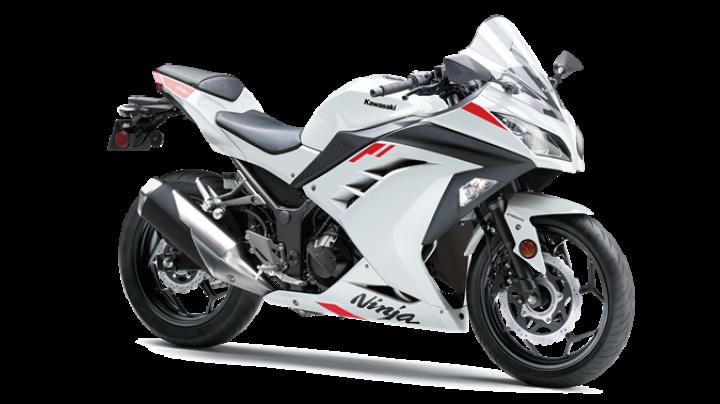

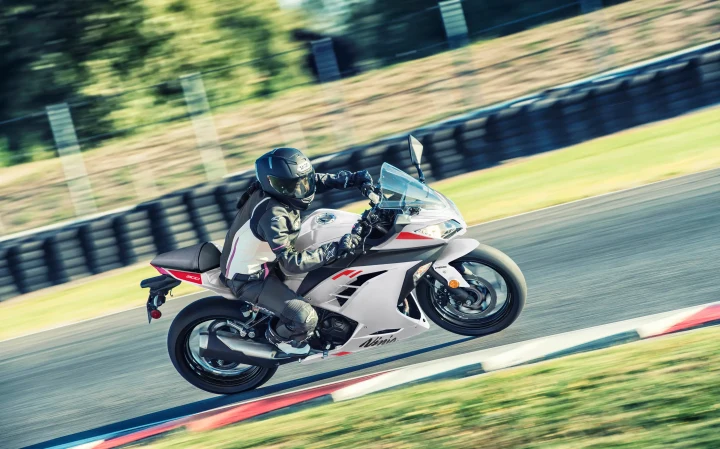
| Feature | Value |
|---|---|
| Brand | KAWASAKI |
| Model | Kawasaki Ninja 300 ABS |
| Engine size | 300 cc |
| Power | 39 hp |
| Torque | 26 Nm |
| Cylinder / Valve | Double Cylinder, 8 valves |
| Weight | 175 kg (386 lb) |
| Front Brake | Single 290 mm disc with dual-piston caliper and ABS. |
| Rear Brake | Single 220 mm disc with dual-piston caliper and ABS system. |
| Seat Height | 78 cm (30.7 in) |
| Front Tyre | 110/70-17 |
| Rear Tyre | 140/70-17 |
| Cooling | Liquid Cooled |
| Front Suspension | / Wheel Travel: 37 mm telescopic fork / 4.7 inches |
| Rear Suspension | / Wheel Travel: Gas-charged shock absorber with adjustable preload Uni-Trak swingarm / 5.2 inches |
| Motorcycle Type | Supersport |
| Top Speed | 180 km/h (112 mph) |
| Fuel Capacity | 17 L (4.5 US gal) |
| Fuel Consumption | 5.5 L/100 km (42.8 mpg US) |
| Prevalence of Service Network | |
| Service Quality | |
| Spare Parts Availability | |
| Price | Price not available |
| For Other Motorcycle Price Lists | Click for KAWASAKI Price List |
Spec-based reading of the Kawasaki Ninja 300 ABS as a Supersport: focus on the numbers that match how you ride — power, weight, seat height, and fuel range — then verify with a dealer test ride.
Pros
- Liquid cooling for more consistent heat management
Who is it for?
Best suited for sport and track-focused riders, newer riders stepping into their first or second motorcycle.
Who is it not for?
Less ideal for riders whose priority is relaxed daily comfort.
Commuting / city use
As a supersport motorcycle, sport ergonomics can feel tiring in slow city traffic.
Highway / longer rides
Highway use is possible, but comfort is usually sport-focused rather than touring-oriented.
Good for beginners?
Based on displacement/power and manageable size, the Kawasaki Ninja 300 ABS can be considered by new or returning riders — still take training and a test ride.
Seat height & rider fit
Seat height is about 780 mm (30.7 in) — mid-range, but personal fit still matters.
Fuel economy & range
Listed fuel use is about 5.5 L/100 km (~42.8 mpg US). With a ~17 L tank, theoretical range is around 309 km (real-world range varies).
Two-up riding
Two-up comfort depends on seat length, passenger pegs, and load capacity — check fit with a passenger before long trips.
Frequently asked questions
What is the top speed of the Kawasaki Ninja 300 ABS?
Our specification data lists 180 km/h (112 mph) for the Kawasaki Ninja 300 ABS.
How much horsepower does the Kawasaki Ninja 300 ABS have?
Listed power is 39 hp.
How much torque does the Kawasaki Ninja 300 ABS have?
Listed torque is 26 Nm.
What is the engine size of the Kawasaki Ninja 300 ABS?
Engine displacement is listed as 300 cc.
How much does the Kawasaki Ninja 300 ABS weigh?
Curb weight is listed at about 175 kg (386 lb).
What is the seat height of the Kawasaki Ninja 300 ABS?
Seat height is about 780 mm (30.7 in).
What is the fuel economy of the Kawasaki Ninja 300 ABS?
Listed consumption is about 5.5 L/100 km (about 42.8 mpg US).
What is the fuel range of the Kawasaki Ninja 300 ABS?
Theoretical range is around 309 km based on tank size and listed consumption; real-world range varies with riding style.
Is the Kawasaki Ninja 300 ABS liquid cooled?
Yes — it is listed as liquid-cooled.
How many cylinders does the Kawasaki Ninja 300 ABS have?
It is listed as a 2-cylinder engine.
Is the Kawasaki Ninja 300 ABS good for beginners?
Based on displacement/power and manageable size, the Kawasaki Ninja 300 ABS can be considered by new or returning riders — still take training and a test ride.
Is the Kawasaki Ninja 300 ABS good for commuting?
The Kawasaki Ninja 300 ABS can be used for commuting, but its sport-focused ergonomics and performance may be less practical for daily urban riding than a commuter, scooter or standard motorcycle.
Is the Kawasaki Ninja 300 ABS good for highway riding?
With a listed top speed of 180 km/h, the Kawasaki Ninja 300 ABS has enough performance for typical highway speeds and overtaking. Long-distance comfort still depends on riding position, wind protection and rider preference.
Is the Kawasaki Ninja 300 ABS suitable for short riders?
Seat height is about 780 mm (30.7 in) — mid-range, but personal fit still matters.
Is the Kawasaki Ninja 300 ABS A2 licence friendly?
A2 licence fit depends on power and power-to-weight limits (≤35 kW and ≤0.2 kW/kg). Based on listed figures, it appears within typical A2 limits — confirm with official manufacturer data.
What are the pros of the Kawasaki Ninja 300 ABS?
Liquid cooling for more consistent heat management.